Ad — affiliate link: This guide contains affiliate links to Gains Nutrition and Optimum Nutrition UK. If you buy through them, we may earn a commission at no extra cost to you. The retailer links are for adults aged 18 and over.
A long rally asks plenty of your legs. The next point asks you to think clearly while you catch your breath. It is understandable to wonder whether a supplement could help with either.
Some ingredients have evidence for specific physical uses. That does not mean every powder, gummy or drink improves padel performance. Nor does evidence for a physical effect establish a benefit for concentration, confidence or shot selection.
The useful question is: which need, which ingredient, and what evidence? Start with regular meals, fluids and a realistic training routine, then consider whether a supplement has a defined role. This is general guidance for adults, not a personal nutrition or dosing plan.
What supplements may contribute
| Category | Evidence or practical role | What it does not establish |
|---|---|---|
| Protein powder | A convenient way to add dietary protein. Protein contributes to growth and maintenance of muscle mass; the authorised claim applies to qualifying foods. | That extra powder improves your game when your diet already meets your needs. |
| Creatine | A qualifying product has an authorised claim for performance in successive bursts of short-term, high-intensity exercise, under the conditions explained below. | A guaranteed improvement in padel skills, match results or concentration. |
| Carbohydrate/electrolyte sports drinks | A convenient way to carry carbohydrate and fluid; the AIS includes sports drinks in its evidence-based sports-food framework for specific situations. | That every session needs one, or that every drink meets the conditions for a particular health claim. |
| Caffeine-containing products | Caffeine is studied in sports performance research, but effects and tolerance vary. Consider the trade-offs discussed below before using a product. | Sharper padel decisions, calmer nerves or better mental health. |
The comparison draws on the GB nutrition and health claims register, the AIS sports supplement framework, and the NIH sports-supplement evidence review. These sources do not establish that products from either linked retailer improve padel performance.
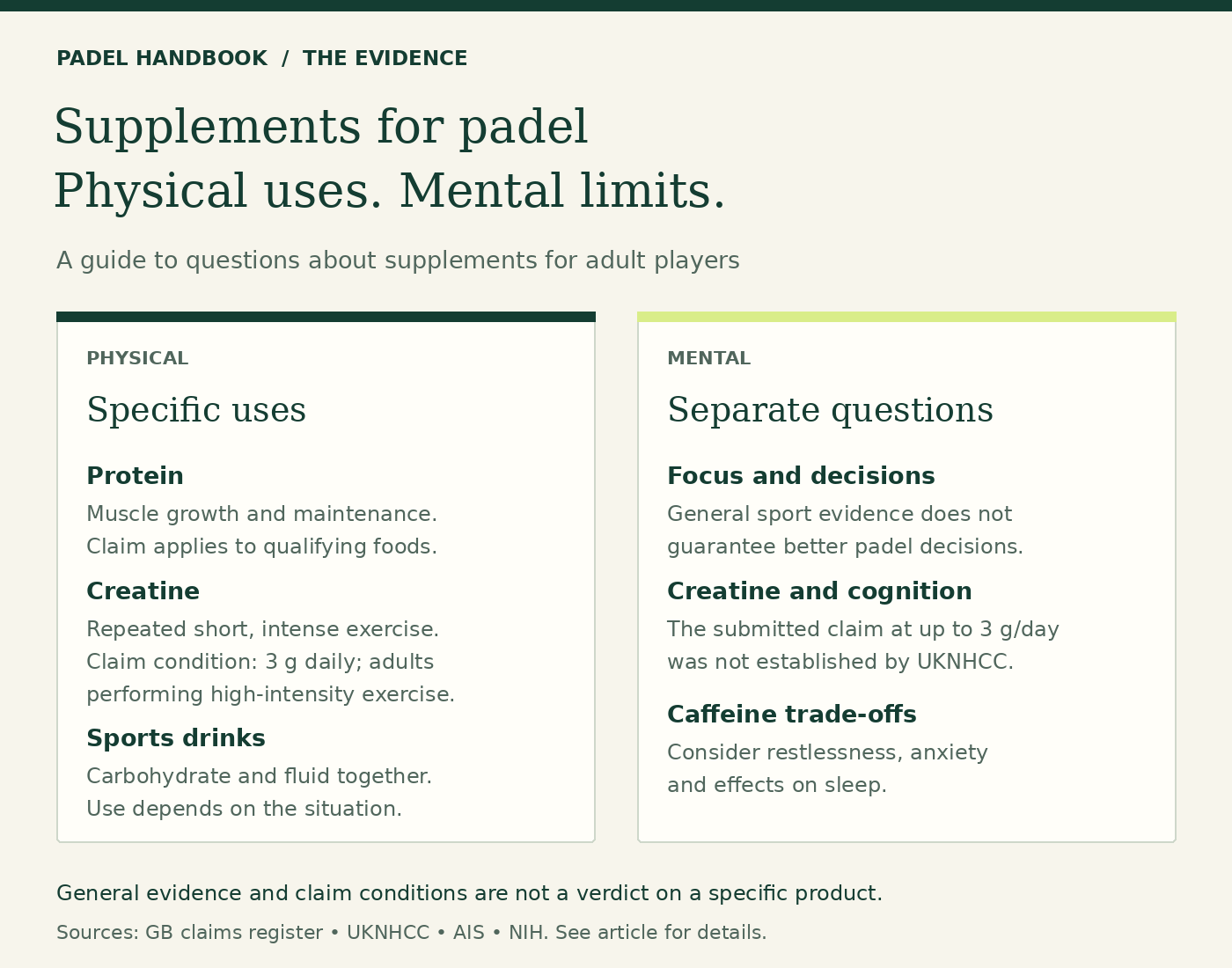
Physical performance: three different jobs
1. Protein is about meeting a nutritional need
Protein contributes to growth and maintenance of muscle mass. That authorised claim is restricted to foods that qualify as a source of protein; it is not a unique advantage of a branded powder.
Everyday foods can provide protein, including beans, lentils, eggs, fish, meat, dairy and suitable alternatives. A powder may be convenient when arranging food is difficult, but first work out what your normal diet provides. The NHS Eatwell Guide is a useful starting point for dietary balance.
For example, an evening player might plan a normal meal after the club instead of automatically buying a recovery product. That is a planning example, not a prescribed menu or a claim that everyone has the same needs.
2. Creatine has a specific physical claim
The GB register permits a claim about increased physical performance in successive bursts of short-term, high-intensity exercise for foods targeting adults who perform high-intensity exercise. The product must provide a daily intake of 3 g of creatine, and consumers must be told that the beneficial effect is obtained at that daily intake.
That explains the conditions of the authorised claim; it is not an instruction that every padel player should take creatine. The evidence for an ingredient is also different from evidence that a particular product supplies it in the claimed amount.
Padel involves repeated efforts, so this type of evidence may be relevant to a player’s questions. That is an application of broader exercise evidence, not proof of a particular improvement on a padel court. For sports use, the AIS creatine guidance focuses on creatine monohydrate and assessment within a wider nutrition plan.
3. Sports food is often a convenience choice
The AIS describes sports drinks as a way to deliver carbohydrate and fluid together. Their usefulness depends on the session, conditions and what you can eat or drink.
For a day with several matches, planning access to food and drinks may matter more than buying the most complicated formula. For a routine social session, start by bringing a refillable bottle and considering whether you have eaten appropriately. NHS guidance notes that fluid needs can increase with heat or prolonged physical activity.
Do not apply the benefits of a specifically formulated carbohydrate-electrolyte solution to every flavoured drink. Check the actual composition and claim conditions.
Mental performance: focus is a separate question
A product that affects physical exercise capacity does not automatically make a player calmer, more tactically aware or more confident.
Caffeine: consider the whole evening
Sports research on caffeine should not be turned into a promise of better padel concentration. The NIH review reports individual differences and possible adverse effects, including restlessness, anxiety and sleep disruption.
For someone with a late booking, a caffeine-containing pre-workout raises a practical question: will its effects fit the rest of the evening? Check all caffeine sources and the label, and do not judge a product only by the sensation of stimulation. This article does not recommend a caffeine dose or make a mental-performance claim for a retailer’s product.
Creatine is not a proven “padel focus” product
In 2024, the UK Nutrition and Health Claims Committee assessed a proposed cognitive-function claim involving creatine. It concluded that a cause-and-effect relationship had not been established for consumption of 3 g per day or less and improved cognitive function. The claim is listed as non-authorised in the GB register.
That finding concerns the submitted claim and its conditions. It does not settle every research question about cognition, but it gives us no basis to advertise creatine as a route to better padel decisions. See the committee’s full scientific opinion.
Match the question to your actual routine
These are illustrative situations, not accounts of product tests.
| Your situation | A useful first check | A supplement decision comes after… |
|---|---|---|
| You arrive at an evening game hungry after work. | Review lunch, the gap before play, and a familiar snack if needed. | Working out whether a food or scheduling change addresses the problem. |
| You have several matches on one day. | Plan food, drinking water, breaks and what you can tolerate between games. | Assessing the event’s demands and your individual requirements. |
| You combine padel with regular strength training. | Look at your overall diet and training plan. | Establishing a specific nutritional need and checking evidence and suitability. |
| You feel distracted or tense during matches. | Notice when it happens and discuss a practical routine with your coach. | Avoiding assumptions that a stimulant or supplement will solve the cause. |
For food planning, the LTA’s return-to-play guide discusses meals and snacks around tennis. It offers related racket-sport context, not a personalised padel prescription.
Do not transfer ingredient evidence to a blended product
A study of one ingredient does not establish the effectiveness or safety of a multi-ingredient blend. The NIH evidence review explains that combinations and ingredient amounts can differ from what researchers studied. If a label does not disclose a relevant amount, this guide cannot confirm that the product matches the evidence. Do not treat a proprietary blend or a retailer link as that confirmation.
Five checks before you buy
- Name the need. What exactly are you trying to change?
- Review food and planning. Could a regular meal, a snack or preparation help?
- Read the product. Check ingredients, allergens, amounts, warnings and label instructions.
- Check the evidence. Does it apply to the ingredient, the actual product and your situation?
- Assess suitability. Ask a qualified professional about individual needs, particularly if you take medicines or have a medical condition.
If you compete under anti-doping rules, UKAD advises checking the actual batch when using batch-tested supplements. No supplement is guaranteed free of prohibited substances. We have not independently verified batch-testing status for Gains Nutrition products.
Post-match nutrition that fits your lifestyle
An evening match can leave little time to shop or cook. Planning a meal or snack, fluids and time to sleep makes post-match nutrition easier to fit around work and family. A protein supplement can be a convenient way to meet a protein need when food is impractical; it is optional when your diet already meets that need.
Protein supports muscle growth and maintenance, but that does not establish that a shake will make you recover faster after padel. The NIH evidence review stresses adequate nutrition and hydration as the foundation, and notes that supplement effects depend on the person and the exercise. No linked brand is being recommended as a treatment for soreness, injury or mental fatigue.
Optional retailer: Optimum Nutrition UK
Ad — we earn commission from purchases through these links.
If a supplement would help you organise your routine, you can browse Optimum Nutrition UK’s range through the link below. Compare the exact product’s ingredients, allergens, serving information and price with your needs before buying. A convenient format is a reason to consider a product, rather than proof of faster recovery.
We have not tested these products or established a padel-specific recovery benefit. This is an optional shopping link, not a product ranking.
Optional retailer link: Gains Nutrition
Ad — we earn commission from purchases through these links.
Gains Nutrition sells sports supplements, including protein and creatine products. If you have assessed your needs and want to compare its range, check the exact product label and current details before ordering.
We have not conducted hands-on testing of these products. The general evidence discussed above does not establish that an individual Gains Nutrition product meets a claim’s conditions or improves padel performance. This link offers a shopping route; it is not a product verdict.
For the rest of your preparation, use our first padel match checklist and beginner equipment guide.
Sources and review
Research checked on 17 October 2026. This guide distinguishes general sport evidence, authorised claim conditions, and what has not been verified for a specific product. No independent nutrition-professional review is claimed.
- GB nutrition and health claims register, updated 19 May 2026: protein and creatine claims and conditions, plus non-authorised claims.
- AIS Group A framework and creatine guidance: use in specific sporting situations.
- NIH Office of Dietary Supplements: exercise and athletic performance: broader research and its limitations.
- UKNHCC creatine cognitive-function opinion, 14 August 2024.
- NHS Eatwell Guide and hydration guidance.
- LTA return-to-play nutrition.
- UKAD managing supplement risks.
- Gains Nutrition retailer range and the programme terms supplied by the publisher.
Read our editorial policy for how we check guides.